
Is ListKit Right for Consultants and Online Service Providers?
A Precision-Based Outreach Analysis
ListKit doesn't try to hide what it's built for.
The platform was founded by agency owners who run high-volume cold email campaigns. The marketing is built around agency owners, sales teams, and founders scaling outbound fast. The pricing starts at $97/month and jumps steeply from there. The headline feature is triple-verified email data from a database of 638 million contacts.
Six hundred and thirty-eight million contacts.
That number tells you everything you need to know about the intended user.
ListKit is Volume-Based Outreach infrastructure, built explicitly and unapologetically for operators who need to move fast through large prospect lists. For that operator, it's a genuinely strong tool.
For consultants and online service providers doing Precision-Based Outreach who need 2–4 new clients per quarter? The mismatch between what ListKit was built for and how consultants and online service providers work is bigger here than anywhere else in this category.
Worth understanding before you sign up.
← Back to: Cold Email Software for Consultants and Online Service Providers
What ListKit Is Designed For
Truth is, ListKit might be the most honest tool in this entire category about its intended user.
The platform was founded by cold email agency owners. The product is built to solve their specific problem: finding high-volume, clean, verified contact data fast and pushing it into outreach campaigns without a bunch of manual cleanup work in between.
ListKit's core features reflect exactly that intent.
A database of over 638 million decision-maker profiles. Triple-verified email data — checking validity, catch-all detection, and deliverability — before the contact ever reaches you. Buying intent data that flags prospects actively researching solutions in your space. Direct integrations with Smartlead, Salesforge, HubSpot, and other sequencing tools so contacts flow straight from the database into a campaign without touching a spreadsheet.
The platform also bundles cold email coaching and training into its mid-tier plan — because the user it was designed for is someone who's actively trying to scale outbound, not someone who already has a precision system and just needs a narrow tool to support it.
This is not a subtle product.
It was built for volume. That's not a criticism — it's the whole point.
The Outreach Model Behind ListKit
ListKit is the most purely volume-oriented tool in this cluster. All three biases are present — and more pronounced here than anywhere else.
Scale bias.
A database of 638 million contacts is not built for someone who needs to find 20 carefully selected prospects per month. It's built for someone who needs to find 10,000 and move fast. The filtering tools, the bulk export, the CRM integrations, the intent data — all of it is optimized for high-throughput prospecting. The implicit assumption in every feature is: you need a lot of contacts, quickly, with clean data, ready to go into a sequence.
Automation bias.
ListKit's signature move is removing friction between list-building and outreach. Find contacts, verify them, push them directly to your sequencing tool, done. No manual cleanup. No spreadsheet wrangling. The value proposition is speed — getting clean data into your outreach system as fast as possible so you can send more, sooner.
For consultants and online service providers, that speed is working against you. The friction ListKit removes — the time between identifying a prospect and contacting them — is exactly where judgment should live. Slowing down to evaluate whether each person is actually worth reaching out to isn't inefficiency. It's the precision work that makes outreach work at your scale.
SDR team assumption.
ListKit's Scale plan is priced for teams ($297/month, up to 3 users). The platform's integrations are built for sales infrastructure — CRMs, sequencing tools, reporting dashboards. The cold email coaching included in mid-tier plans is designed for people building or running outbound sales operations, not solo consultants and online service providers looking for a targeted handful of client conversations per quarter.
Where ListKit Works Well
Consider this: ListKit has real fans, and for good reason.
Cold email agencies running campaigns for multiple clients are the natural home for the tool.
The triple verification reduces bounce rates, which protects deliverability across client campaigns. The bulk export and direct integrations mean less time in spreadsheets between list-building and sending.
For an agency whose whole business is high-volume outbound, that efficiency has direct ROI.
SDR teams at growth-stage companies benefit from the intent data, which surfaces prospects actively researching solutions similar to yours. In high-volume B2B outreach, reaching someone when they're actively in-market is a meaningful conversion lever.
Founders scaling cold outbound aggressively — sending thousands of emails per month to grow a pipeline quickly — benefit from the database breadth and the verification quality. If you need 100,000 verified contacts and you need them fast, ListKit is built for that.
The pattern is consistent across every good use case: high volume, clean data, speed from list to send, team or dedicated operator managing the workflow.
The Judgment Gap for Consultants and Online Service Providers Using ListKit
Here's where the honest conversation happens.
ListKit is the tool most likely to make consultants and online service providers feel like they're finally solving their outreach problem — and the tool most likely to produce exactly the frustrating results they were trying to escape.
Here's why.
The Judgment Gap is the space between access to automation and strategic client selection. It occurs when consultants and online service providers outsource decision-making to tools built for volume.
ListKit is extraordinarily good at the access to automation part. Triple-verified data. 638 million contacts. Buying intent signals. Direct integration with your sequencing tool. Clean data in, campaigns out, fast.
What it cannot do — what no tool in this category can do — is answer the question that determines whether any of it works for you:
Is this person actually worth reaching out to right now?
And here's the specific trap with ListKit: the buying intent data.
Intent data sounds like judgment.
It sounds like the tool is identifying people who are actively looking for your solution — which is, in theory, exactly the selectivity that makes precision outreach work.
But intent data is still volume logic.
It surfaces people who have visited certain websites, searched certain terms, or engaged with certain content categories. It tells you they're in-market for a category of solution. It doesn't tell you whether they're the right client for you specifically — whether their situation matches your expertise, whether your offer fits their stage, whether this is a conversation worth your time.
Consultants and online service providers win clients through specificity and relevance, not category proximity. Intent data narrows the pool. It doesn't do the judgment work.
So what happens in practice:
A consultant or online service provider uses ListKit's intent data to build a list of 500 "in-market" prospects. The data is clean. The verification is solid. The list looks promising. They push it into a sequencing tool and start sending.
And then they get the same problem they had before — low reply quality, mismatched conversations, discovery calls that go nowhere — just with cleaner data underlying it.
The tool worked. And the model was wrong.
What ListKit Costs a Consultant Or Online Service Provider
ListKit is the most expensive tool in this cluster by a significant margin. Let's look at the full picture.
Subscription Cost
ListKit's plans in 2025/2026:
Professional: $97/month — 2,000 email credits, 100 mobile credits, CRM integrations
Scale: $297/month — 10,000 email credits, 500 mobile credits, intent data, 1-on-1 cold email coaching, Cold Email Mastery program
Ultimate: $599/month — 10,000 email credits with additional credits at $49/1,000
Elite: $1,199/month — 40,000 email credits
Credits roll over month-to-month, which is a genuine advantage over tools like Apollo and some Hunter plans. Additional credits run $39–$59 per 1,000 depending on your plan tier.
For a solo consultant or online service provider, the Professional plan at $97/month is the entry point. That's nearly three times the cost of Hunter's Starter plan, and meaningfully more than Woodpecker's entry tier.
At $97/month, you're paying for 2,000 email credits. Precision-Based Outreach — 15–30 carefully selected prospects per month — uses roughly 1.5% of that capacity. You're paying for volume infrastructure you don't need.
Time Cost
Setup hours: ListKit is simpler to set up than Apollo or Lemlist because its scope is narrower — it's a data platform, not a full sequencing suite. Getting up and running: 5–10 hours, including CRM or sequencing tool integration.
At $150/hour: $750–$1,500 in setup time. At $250/hour: $1,250–$2,500.
Weekly usage time: How you use ListKit determines your time cost. If you're using it as intended — building large lists quickly for volume outreach — the tool is fast. If you're using it for precision outreach — carefully evaluating each contact before reaching out — the speed advantage disappears and you're paying for database infrastructure you're barely touching.
Weekly management: ListKit is primarily a data tool, not a sequencing platform. Ongoing management time is lower than Apollo, Lemlist, or Woodpecker — but the list evaluation work and the outreach execution happen elsewhere, in separate tools. Factor in time for those.
At $150/hour and 2–3 hours/week for list work and evaluation: $1,200–$1,800/month.
The coaching and training included in the Scale plan: The Cold Email Mastery program and 1-on-1 coaching bundled into the $297/month Scale plan are genuinely valuable resources — for someone who's building a high-volume outbound operation. For a consultant or online service provider doing precision outreach, they're solving a problem you don't have. You're paying for training on a model that doesn't fit your leverage.
Strategic Cost
Volume pressure: ListKit's whole design philosophy is throughput. Fast from list to send. High-volume, clean data, into your sequence, done. For consultants and online service providers, that pressure is loud and consistent. The tool is always asking: why aren't you sending more?
Reputation risk: Higher here than with any other tool in this cluster. ListKit's strength — speed from list to sequence — makes it easier than anywhere else to send outreach before you've done the judgment work. Fast, clean, wrong is still wrong. And at the scale ListKit is designed for, wrong at scale damages your sender reputation, your professional reputation, and your relationship to outreach in general.
Decision outsourcing: The intent data is the specific risk here. It's the most sophisticated version of outsourcing the "who" decision to a tool. Intent signals are useful data. They're not a substitute for knowing your best clients well enough to recognize who's actually worth a conversation.
Cognitive overload: Lower than Apollo (simpler interface, narrower scope), but the integration work — connecting ListKit to a sequencing tool, managing credits, understanding the intent data layer — adds complexity that a precision operator doesn't benefit from.
The actual math
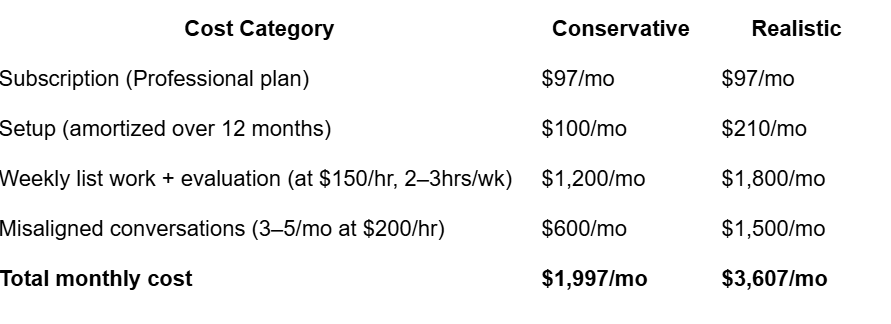
The subscription is the highest in this cluster. And it's still not the biggest expense.
When ListKit Makes Sense
ListKit makes sense when volume is genuinely the strategy — not a workaround for an unclear ICP, but a deliberate, well-resourced approach to building pipeline at scale.
Specifically:
Cold email agencies billing clients for outbound campaigns benefit from the data quality and the direct integrations. Triple-verified data at scale is exactly what that use case requires.
Sales teams at growth-stage companies with dedicated SDRs and a pipeline target that requires hundreds of conversations per month will find the intent data and database depth genuinely valuable.
Founders in the early stages of building a business, before their ICP is clear, who need to run volume experiments to find product-market fit — ListKit gives them clean data to run those experiments with.
The honest pattern:
Volume is the deliberate strategy, you have the infrastructure to execute it, and the business model supports the math of low-percentage conversion at high volume.
And at $97–$297/month, you'd be paying ListKit's prices to use 2% of its capacity.
If You're Playing a Precision Game Instead
Let me be direct about something.
ListKit is the tool in this cluster where the mismatch with consultant leverage is clearest. Not because it's a bad tool — it's a well-built tool that does exactly what it says. But because its design intent is so explicitly volume-oriented that using it for precision outreach is like using a firehose to water a window box.
The power is real. The application is wrong.
If you need to send 5,000 emails a month, ListKit might be exactly the right data infrastructure. The triple-verification, the intent signals, the bulk export — all of it earns its cost at that volume.
If you need 3 good clients per quarter, those same features are solving problems you don't have.
Precision-Based Outreach doesn't need 638 million contacts. It needs a clear picture of the 20 people worth reaching out to this month — and the judgment to know why those 20 people specifically, and what to say that's actually relevant to their situation right now.
That judgment doesn't come from a database. It comes from knowing your best clients deeply and building a process for recognizing them.
That's The Judgment Gap. And it's what separates an outreach system that produces 3 great clients per quarter from one that produces a lot of activity and not enough of the right conversations.
If You're Realizing the Problem Isn't the Software
Truth is, ListKit is a great tool for the operator it was designed for.
That operator isn't most consultants and online service providers.
And if you've been chasing a volume solution to what is actually a precision problem — more data, better verification, faster list-building — the frustrating results probably had nothing to do with the quality of the data.
If that's landing for you... come see what the precision game looks like instead.
This Thursday at 1pm MT, I’m running a free, live training called Never Stare at a Cold Email Again.
It's not a pitch or a replay dressed up as a “live, on demand” webinar.
This is a live training on what we've been talking about here:
Why volume works for SaaS but quietly breaks down for consultants and online service providers — and why better data doesn't fix a model problem.
How to close The Judgment Gap — what it looks like to run outreach where the selectivity is built into the process, not bolted on through intent data.
How to run Precision-Based Outreach in 3 hours a week — the exact framework I use and help you install inside The WARM Client Method, live, so you can see how it works before you invest a dollar.
More data isn't the answer.
Come see what the precision game looks like instead.
→ Register for Never Stare at a Cold Email Again — free training on Thursday at 1pm MT
Also in this series: [Apollo] · [Lemlist] · [Woodpecker] · [Hunter]
← Back to: Cold Email Software for Consultants and Online Service Providers