
Is Woodpecker Right for Consultants and Online Service Providers?
A Precision-Based Outreach Analysis
Woodpecker is one of the cleanest, most focused cold email tools on the market.
No bloat. No feature sprawl. No CRM trying to eat your life. Just cold email sequencing — done well, with genuinely strong deliverability infrastructure built in.
I had a client who used Woodpecker for Precision-Based Outreach. He spent hours getting it configured. When he finally walked me through how he'd set it up... it technically worked. But it sounded absolutely exhausting. And the time he'd spent engineering his setup was more than the time he'd actually spent doing outreach.
That's the Woodpecker story for consultants and online service providers in one sentence: the tool works. The cost of making it work is the problem.
Woodpecker charges per "contacted prospect" — the number of new people you add to a campaign each month. That model assumes you need to contact a lot of new prospects, consistently, every month. That's the throughput assumption of Volume-Based Outreach baked directly into the billing logic.
For consultants and solo service providers who only need 2–4 new clients per quarter? That assumption doesn't match how you work. And the friction that creates is worth understanding before you set up a domain, warm it up, and spend three weeks getting a system running.
← Back to: Cold Email Software for Consultants and Online Service Providers
What Woodpecker Is Designed For
Truth is, Woodpecker made a deliberate choice that most tools haven't: to do one thing and do it well.
That thing is cold email sequencing with strong deliverability.
No database of millions of contacts. No LinkedIn automation. No built-in dialer. Woodpecker focuses on what happens after you have a list — getting your emails into inboxes, automating follow-ups, tracking engagement, and protecting your sender reputation while you do it.
The platform includes email warm-up, catch-all email verification, bounce protection, inbox rotation across multiple sending accounts, A/B testing, and condition-based follow-up sequences. All of it is built to keep deliverability high while you run consistent outbound campaigns.
Woodpecker is popular with agencies managing outbound for multiple clients, B2B sales teams that already have a data source (like Apollo or Hunter) and need a reliable sequencing layer, and outbound specialists who want a dedicated tool rather than an all-in-one platform.
The design intent is consistent: reliable, deliverable, automated cold email at scale. The specialization is what makes it strong. And it's what makes it worth examining carefully before assuming it fits how you work.
The Outreach Model Behind Woodpecker
Woodpecker's model is Volume-Based Outreach — focused and well-executed, but volume-based at its core.
Here's how the three biases show up:
Scale bias. Woodpecker's entire pricing architecture is built around monthly contact volume. The Starter plan gives you 500 contacted prospects per month. The Growth plan: 10,000. The Scale plan: 100,000. The implicit message in every tier: you should be contacting more people. The tool is designed to support that, not to help you figure out whether you should.
One note worth flagging: Woodpecker charges per "contacted prospect" — not per email sent. Follow-up emails to existing contacts don't count against your limit. But every new person you add to a campaign does. This means the meter is always running on list growth, which is exactly the orientation Volume-Based Outreach requires.
Automation bias. Woodpecker's core value proposition is removing manual work from the sequence process. You configure the emails and the timing once; the tool handles execution, follow-up, and reply detection automatically. The goal is to let you run more campaigns simultaneously without proportionally more time. That's leverage — for the operator running high volume. For a consultant sending 30–50 emails a month, the automation is solving a problem that doesn't exist at your scale.
SDR team assumption. Woodpecker's multi-client agency panel, its slot-based pricing (where one person can manage multiple email accounts), and its inbox rotation features are all built for teams coordinating volume outreach. The deliverability infrastructure — inbox rotation, warm-up, bounce shields — assumes you're sending at a volume where those protections matter. At 20–40 emails a month, your deliverability isn't the bottleneck.
Where Woodpecker Works Well
Consider this: Woodpecker has a genuinely loyal user base, and for good reason.
Agencies doing outbound for multiple clients are the natural home for the tool. The multi-client panel, white-labeling options, and slot-based pricing structure are specifically designed for that use case. If you're managing cold email campaigns for 10 clients simultaneously, Woodpecker's architecture handles that cleanly.
B2B sales teams that have already solved the "who to contact" problem — they have Apollo or Hunter for data, they know their ICP well, and they just need reliable sequencing — benefit from Woodpecker's deliverability focus. The tool does that job well without the distraction of features they don't need.
Outbound specialists and sales consultants (who are running outbound for clients, not to find clients) fit the use case well. Volume is the job. Clean execution is the need. Woodpecker delivers both.
The pattern: consistent, high-volume outreach, managed by someone whose job includes running and maintaining the campaigns, in a business model where the math of volume conversion works.
The Judgment Gap for Consultants and Online Service Providers Using Woodpecker
Here's what's interesting about Woodpecker specifically.
The tool is genuinely simpler and more focused than Apollo or Lemlist. Less to configure. Less to manage. Cleaner interface. Fewer features competing for your attention.
And yet The Judgment Gap still shows up — not because of the tool's complexity, but because of what the tool doesn't do.
The Judgment Gap is the space between access to automation and strategic client selection. It occurs when consultants and online service providers outsource decision-making to tools built for volume.
Woodpecker automates the sending layer beautifully. But the sending layer was never where consultants and online service providers struggle. The struggle is upstream: figuring out who to contact, why to contact them, and what to say that's actually relevant to their specific situation right now.
Woodpecker has no opinion about any of that. You bring the list; it sends the emails.
And here's what that looks like in practice.
My client who used Woodpecker for Precision-Based Outreach spent hours — genuinely, multiple hours — getting his setup configured correctly. Domain warm-up, sending limits, sequence conditions, list imports. When he walked me through how he'd done it, it technically worked. But the way he described it? Exhausting. And when I asked how much time he'd spent on outreach itself — the actual emails, the actual prospect selection — it was less than the time he'd spent on the tool.
That's The Judgment Gap in a real scenario.
He'd built a sophisticated system for executing outreach. He hadn't solved the problem of who to reach out to or what to say. The tool consumed the time and energy that should have gone into judgment.
For Volume-Based Outreach, that's fine — you're expected to bring a large, filter-built list, and the tool's job is throughput. But for consultants and online service providers running Precision-Based Outreach, the work happens before the send, not during it. The tool that makes sending faster doesn't solve the judgment problem that actually determines whether your outreach works.
There's a subtler issue specific to Woodpecker's prospect-volume pricing model:
The price you pay goes up as you contact more people. The implicit incentive is always toward scaling your list. But for consultants and online service providers, scaling the list is the wrong direction. The goal isn't to contact more people — it's to contact the right people. A pricing model that rewards volume is quietly misaligned with a precision strategy, even if the tool itself is simpler than the alternatives.
Every month, the contacted-prospect meter resets. And every month, the implicit question from the billing logic is: why aren't you using your limit?
For consultants and online service providers, that question has a good answer: because you only needed to contact 40 people this month, and they were the right 40 people.
That's not a failure of utilization. That's Precision-Based Outreach working correctly. But it's hard to feel that way when you're paying for 500 slots and using 40 of them.
What Woodpecker Actually Costs a Consultant
Subscription Cost
Woodpecker's pricing is prospect-volume based, not per-user. Plans in 2026:
Starter: $24/month (billed annually) or $35/month (billed monthly) — 500 contacted prospects/month
Growth: $84–$126/month — up to 3,000–10,000 contacted prospects/month (varies by source)
For a solo consultant doing precision outreach, the Starter plan is the relevant tier. At $24–$35/month, it's one of the lowest subscription costs in this category.
But here's the reality:
500 contacted prospects per month is far more than most consultants and online service providers doing Precision-Based Outreach will use.
You're paying for volume capacity you don't need — because the plan is built for an operator who does.
Additional costs: Woodpecker doesn't include a contact database, so you need a separate list-building source (Hunter, Apollo, LinkedIn Sales Navigator, or manual research). That's an additional tool cost and time cost on top of the subscription.
Realistic subscription cost for a solo consultant: $24–$35/month for the base plan, plus whatever your list-building infrastructure costs separately.
Time Cost
Setup hours: Woodpecker is simpler to set up than Apollo or Lemlist, which is a genuine advantage. Getting fully operational — domain connection, email warm-up, sequence configuration, list import, deliverability setup — realistically takes 8–15 hours for a solo operator. Less than the competition, but still meaningful.
At $150/hour: $1,200–$2,250 in setup time. At $250/hour: $2,000–$3,750.
Configuration hours: The interface is cleaner than most alternatives. Call it 3–5 hours to get genuinely comfortable with the sequence builder, condition logic, and reporting. Less learning curve than Apollo or Lemlist.
Weekly management hours: Even the simpler tools require management. Monitoring sequences, handling replies, reviewing deliverability, cleaning bounced contacts, updating lists.
For a solo operator running active campaigns:
2–4 hours per week — somewhat lower than more complex platforms, but the time cost is still real.
At $150/hour and 3 hours/week: $1,800/month in ongoing management time. At $200/hour: $2,400/month.
List-building time: Because Woodpecker doesn't include a contact database, list building is a separate activity. Whether you're using Hunter, manual LinkedIn research, or another source, add 1–3 hours per week for prospecting and list preparation.
At $150/hour and 2 hours/week of list work: $1,200/month in prospecting time.
Deliverability work: Woodpecker's deliverability infrastructure is strong, but it doesn't run itself. Monitoring warm-up status, checking sender scores, troubleshooting domain issues — add an hour or two per month for maintenance, more if problems surface.
Strategic Cost
Volume pressure: Woodpecker's pricing structure creates quiet pressure toward using your monthly contact limit.
The value logic of the tool is: contact more people, send more emails, generate more replies.
For consultants and online service providers whose value logic is the opposite — fewer, better conversations — that pressure points in the wrong direction every month.
Reputation risk: Woodpecker has strong deliverability features, which helps protect sender reputation technically.
But reputation with prospects — the professional standing that makes referrals happen and warm introductions land — isn't protected by deliverability infrastructure. It's protected by sending outreach that's genuinely relevant and well-targeted.
No tool can do that for you.
Decision outsourcing: The cleaner the tool, the easier it is to mistake execution quality for judgment quality.
Woodpecker makes it easy to run clean, well-delivered campaigns. It doesn't make it easier to figure out who those campaigns should be going to.
That question — the most important one in your outreach process — still falls entirely on you.
And if you're filling the prospect-volume capacity with contacts that weren't carefully selected, the clean execution works against you: you're efficiently reaching the wrong people.
Cognitive overload: Lower than Apollo or Lemlist.
This is a genuine advantage of Woodpecker's focused approach — less to learn, less to manage, less to maintain. For consultants and online service providers, this is the platform's most legitimate selling point.
The actual math
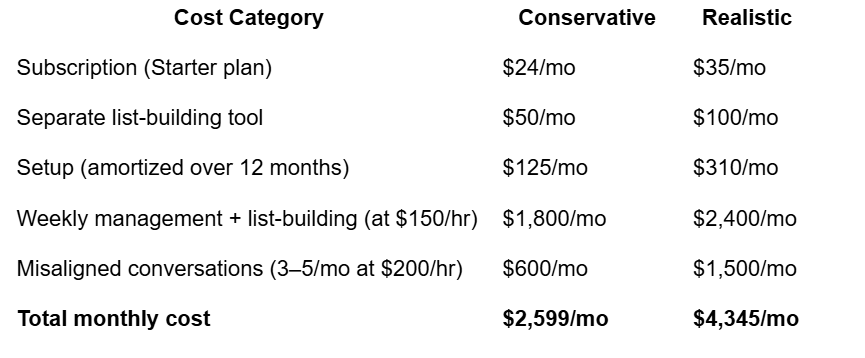
The subscription is affordable.
However: your time is still the expense.
When Woodpecker Makes Sense
Woodpecker makes sense in a few specific situations.
If you're an agency managing cold email campaigns for multiple clients, Woodpecker's architecture was designed for exactly that. The agency panel, the multi-client management, the slot-based billing — all of it maps to that use case cleanly.
If you already have a solid list-building process and a clear ICP, and you just need a reliable sequencing layer, Woodpecker is a strong, focused choice. It does the execution job well without the overhead of platforms trying to do everything.
If you're in a high-volume B2B market where consistent outreach is part of your business development infrastructure
— and you have dedicated time to run it —
Woodpecker's simplicity is an asset compared to more complex alternatives.
If you want to start simple and learn cold email fundamentals without getting buried in features, the Starter plan at $24/month is one of the lowest-risk entry points in the category.
The common thread: volume is the strategy, execution is the bottleneck, and you have the time and business model to support consistent high-volume outreach.
If You're Playing a Precision Game Instead
Here's what's worth saying plainly about Woodpecker.
Of all the tools in this category, Woodpecker is the one most likely to feel manageable to a solo consultant. The price is low. The interface is clean. The learning curve is real but not brutal.
And that manageability is actually the trap.
Because manageable doesn't mean aligned. A tool that's easy to run for the wrong model is still running the wrong model — just with less friction on the way to the same result.
If you need to send 5,000 emails a month, Woodpecker is genuinely one of the better tools to do it with. The deliverability is strong, the pricing is fair, the interface won't bury you.
But if you need 2–4 new clients per quarter, and your time is worth $150–$300/hour, the question isn't which volume tool is easiest to manage.
The question is whether volume outreach is the right model at all.
Precision-Based Outreach doesn't need a sequencing tool running 500 contacts per month. It needs a clear picture of who your 15–30 highest-probability prospects are right now, a process for understanding their situation before you reach out, and outreach that reflects genuine knowledge of their world.
That's not a tool problem. That's a judgment problem. And judgment is exactly what The Judgment Gap is about.
Tool requirement for Precision-Based Outreach is minimal.
The thinking requirement is high.
And for consultants and online service providers billing $150–$300/hour, that's the right trade — because you're trading tool complexity for judgment quality, and your judgment is worth far more than any monthly subscription.
If You're Realizing the Problem Isn't the Software
Truth is, Woodpecker is one of the most honest tools in this category. It doesn't oversell. It does what it says. The deliverability is real.
And it's still built for a different game than the one most consultants and online service providers are playing.
If that's landing for you... come see what the precision game looks like.
This Thursday at 1pm MT, I’m running a free, live training called Never Stare at a Cold Email Again.
It's not a pitch or a replay dressed up as a “live, on demand” webinar.
This is a live training on what we've been talking about here:
Why volume works for SaaS but quietly breaks down for consultants and online service providers — and why that's a model problem, not a willpower problem.
How to close The Judgment Gap — what it actually looks like to run outreach around your judgment instead of a contact-volume limit.
How to run Precision-Based Outreach in 3 hours a week — the exact framework I use and help you install inside The WARM Client Method, live, so you can see how it works before you invest a dollar.
If the problem isn't the software...
Come see what the precision game looks like instead.
→ Register for Never Stare at a Cold Email Again — free training on Thursday at 1pm MT
Also in this series: [Apollo] · [Lemlist] · [Hunter] · [ListKit]
← Back to: Cold Email Software for Consultants and Online Service Providers