
Is Lemlist Right for Consultants + Online Service Providers?
A Precision-Based Outreach Analysis
Lemlist is one of the most creative cold email platforms out there.
Personalized images. Video thumbnails. LinkedIn automation. Multi-channel sequences that combine email, social, and calls into one workflow.
The platform does things most competitors don't — and does them well.
It's also built for a fundamentally different kind of operator than most consultants and online service providers.
Lemlist is designed for sales teams and agencies running high-volume, multi-channel outreach at scale. The personalization features — which are legitimately impressive — are designed to improve reply rates across large send volumes, not to replace the judgment required to decide who's actually worth contacting.
That distinction matters.
And it's what this post is about.
← Back to: Cold Email Software for Consultants and Online Service Providers
What Lemlist Is Designed For
Consider this:
Lemlist was founded on a specific insight — that cold email that looks like cold email gets ignored, and cold email that looks personal gets replies.
That insight is correct.
And Lemlist built a platform around it.
The tools it built:
custom image personalization (your prospect's name or company logo embedded in a graphic)
video thumbnails with personalized text overlays
LinkedIn connection steps woven into email sequences
automated call tasks
and conditional logic that adapts sequences based on how prospects engage.
The intended user: a sales team or outbound agency that needs to send hundreds or thousands of emails per month and wants those emails to stand out in crowded inboxes.
The operating assumption: volume is necessary, so the personalization layer is what makes volume work better.
Everything in the platform — the multichannel sequences, the AI-assisted writing tools, the built-in email warm-up (Lemwarm), the lead database — points toward the same goal:
Help teams send more outreach that feels more personal at scale.
That's a coherent product vision. And it works for the operator it was designed for.
The Outreach Model Behind Lemlist
Lemlist is Volume-Based Outreach with a personalization layer on top.
That's not a criticism. It's the model.
Here's how the three core biases show up inside the platform specifically:
Scale bias. Lemlist's lead finder, database integrations, and CSV import tools are all built to help you build large lists quickly. The platform's personalization features are designed to operate at scale — image personalization uses merge tags to customize thousands of emails automatically. The assumption: you're sending to a lot of people, and the personalization layer is what helps you cut through.
Automation bias. The multi-channel sequence builder is the heart of the platform. You design a workflow — email on day 1, LinkedIn view on day 3, connection request on day 5, follow-up email on day 7 — and the tool executes it automatically across your entire list. The goal is to remove manual decision-making from the outreach process so you can run more sequences simultaneously.
SDR team assumption. Lemlist's pricing is per-user and scales with team size. The platform's multi-channel features — coordinating email, LinkedIn, and calls — assume someone has time to manage the tool actively, monitor sequences, handle replies, and optimize campaigns. That's a meaningful time commitment. For a solo consultant, that time has a very specific dollar cost.
The personalization features are real and genuinely differentiated. But personalization that's automated across a large list is still volume outreach. It's more thoughtful volume outreach — but the model underneath is the same.
Where Lemlist Works Well
Truth is, Lemlist is a strong tool in the right context.
Agencies running outbound campaigns for multiple clients are a natural fit. The multi-channel workflow, the client reporting features, the team collaboration tools — all of it was built for that use case.
Sales teams at growth-stage companies benefit from the personalization layer because it helps them differentiate in competitive markets where everyone's inbox is full. If you're sending 500 emails a month to VP-level buyers at mid-market SaaS companies, Lemlist's image personalization and LinkedIn automation genuinely improve reply rates.
Recruiters doing high-volume outreach to passive candidates are another strong use case. The platform's ability to combine LinkedIn touchpoints with email sequences maps well to how modern recruiting outreach works.
In all of these cases, the pattern is consistent: large list, high send volume, dedicated person or team managing the tool, business model that justifies the cost of volume outreach.
If that's your situation, Lemlist is worth evaluating seriously.
The Judgment Gap for Consultants and Online Service Provider Using Lemlist
Here's where it gets interesting for consultants and online service providers specifically.
Lemlist's personalization features are seductive. And they should be — they're genuinely impressive. The idea that you can send something that looks personal and relevant to hundreds of prospects automatically is appealing.
But here's the thing about automated personalization: it looks personal. It isn't.
The Judgment Gap is the space between access to automation and strategic client selection. It occurs when consultants and online service providers outsource decision-making to tools built for volume.
Inside Lemlist, The Judgment Gap shows up like this:
You build a list of 400 prospects. You design a sequence: email with a personalized image on day 1, LinkedIn connection on day 4, follow-up email on day 8. You set the conditions, you hit launch.
The tool executes perfectly. The emails go out with your prospect's company name embedded in a custom graphic. It looks like you spent 20 minutes on each one.
But you didn't answer the question that matters: Is this person actually worth reaching out to right now?
The image personalization answers "does this look personal?" — not "is this relevant to this person's actual situation?" Those are very different questions. And for consultants and online service providers, the second question is the one that drives results.
When automation replaces discretion, what you get is outreach that looks thoughtful but isn't. Replies come in from people who were impressed by the creative execution but aren't actually a fit. Or the sequence runs to completion on 400 people who weren't the right 400 people to begin with.
The tool worked. The judgment wasn't there to make the tool work for you.
And for consultants, where reputation is the pipeline and every mismatched discovery call costs real money in time — that gap is expensive.
What Lemlist Actually Costs a Consultant
Same principle as always: the subscription is not the expense.
Subscription Cost
Lemlist's paid plans in 2026 start at $55–$69/user/month for the Email Pro plan (pricing varies by billing period — annual billing gets you a discount). The Multichannel Expert plan, which includes LinkedIn automation and calling features, runs $79–$99/user/month.
For a solo consultant, the Email Pro plan is the relevant tier. Call it $55–$69/month on annual billing.
Here's the catch: Lemlist uses a credit system for its lead database features. Credits don't roll over month to month. If you build your own list externally and import it, you can largely avoid this — but if you use Lemlist's built-in lead finder for any prospecting, credits burn faster than expected and don't carry over.
Add-ons — additional sending accounts beyond the three included, extra credits, advanced integrations — can push the real monthly cost meaningfully higher than the base plan suggests.
Realistic subscription cost for a solo consultant using the tool properly: $70–$120/month.
Time Cost
Setup hours: Lemlist has more moving parts than a basic sequencing tool. Getting the full setup right — email account connection, domain warm-up via Lemwarm, sequence design, personalization variable setup, lead list import or database configuration — realistically takes 15–25 hours.
At $150/hour: $2,250–$3,750 in setup time before a single email goes out. At $250/hour: $3,750–$6,250.
Configuration hours: The multi-channel sequence builder is powerful and has a learning curve. Image personalization requires design work or template setup. Conditional logic requires configuration. Add 5–10 hours for getting genuinely comfortable with the platform's more advanced features.
Weekly management hours: Lemlist sequences require monitoring — reply handling, bounce management, sequence adjustments, deliverability checks, LinkedIn step monitoring (if using Multichannel). For a solo operator running active campaigns: 3–5 hours per week.
At $150/hour and 4 hours/week: $2,400/month in ongoing management time. At $200/hour: $3,200/month.
Deliverability work: Lemwarm handles the baseline, but deliverability issues still occur — especially as send volume scales or if domain reputation dips. Troubleshooting, re-warming, and domain management add unplanned hours that are genuinely hard to forecast.
Strategic Cost
Volume pressure: Lemlist's platform is designed to run campaigns. The implicit message of the interface — build a list, launch a sequence, monitor results, optimize and repeat — is always pushing toward more. More contacts, more sequences, more sends. For consultants and online service providers who only need 2–3 new clients per quarter, that pressure points in the wrong direction.
Reputation risk: The personalization features make it easy to send outreach that looks personal without doing the judgment work that makes it personal. For consultants and online service providers in tight professional networks, the downside of outreach that feels off — even if it's visually impressive — is real. A personalized image with someone's company name doesn't fix a message that isn't actually relevant to their situation.
Decision outsourcing: The multi-channel automation is genuinely impressive. It's also genuinely easy to let the automation make decisions that your judgment should be making. Which 20 people are worth a LinkedIn connection request this month? Lemlist can execute that action. It can't help you figure out who those 20 people should be.
Cognitive overload: Lemlist has more features than most consultants and online service providers will ever use — image personalization design, video thumbnails, call tasks, LinkedIn automation, conditional sequence logic, AI writing assistance. Learning, maintaining, and optimizing a multi-channel platform is a real cognitive load. For consultants and online service providers working limited hours on business development, that load competes directly with the judgment work that actually drives results.
The actual math
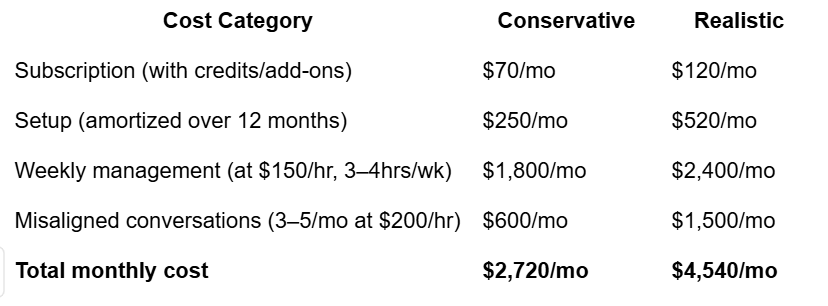
The personalization features are real.
The time cost of running them is also real.
When Lemlist Makes Sense
Let me be direct here.
Lemlist makes sense if you're running multi-channel outreach at meaningful volume and have the time or team to manage it properly.
Specifically:
If you're an agency doing outbound for multiple clients and multi-channel coordination is part of your service offering, Lemlist is genuinely well-built for that workflow.
If you're a growth-stage company with a sales hire or an SDR whose job is outreach, and you want them running LinkedIn + email sequences, Lemlist's multichannel features are differentiated and worth the cost.
If you're in a market where visual differentiation actually moves reply rates — competitive inboxes, sophisticated buyers who've seen every cold email template — Lemlist's personalization tools can genuinely help.
If you're a recruiter doing volume outreach across LinkedIn and email, the platform's workflow is a strong fit.
The pattern: volume, team or dedicated time, multi-channel need, business model that supports the cost.
If you're a solo consultant who needs 3 clients per quarter and has 5 hours a week for business development... Lemlist is solving a problem you don't have, at a cost you can't afford to ignore.
If You're Playing a Precision Game Instead
Here's the honest version of this.
Lemlist's creative personalization features are genuinely impressive. And they're solving a real problem — how do you stand out in a crowded inbox when everyone's running sequences?
But for consultants and online service providers, that's not actually the problem.
The problem isn't standing out at scale.
That's a judgment problem.
And Lemlist — like every volume-based platform — was built to solve a throughput problem.
Precision-Based Outreach doesn't need animated images or multi-channel automation. It needs a clear picture of who your best clients are, a repeatable process for finding people who match that picture, and outreach that reflects genuine understanding of their situation.
That approach requires less tool. More judgment.
And it runs in 3 hours a week — not because the tool is faster, but because you're not managing a platform designed for a team.
If you need to send 5,000 emails a month, Lemlist might be exactly right. But if you need 3 great clients per quarter and your time is worth $150–$300/hour, Precision-Based Outreach is the model that fits how you actually work.
If You're Realizing the Problem Isn't the Software
Consider this: most consultants and online service providers who've tried Lemlist and felt underwhelmed by the results didn't fail at the tool.
They used a sophisticated platform built for volume outreach and wondered why it didn't solve a precision problem.
If that's resonating... come see what the precision game looks like instead.
This Thursday at 1pm MT, I’m running a free, live training called Never Stare at a Cold Email Again.
It's not a pitch or a replay dressed up as a “live, on demand” webinar.
This is a live training on what we've been talking about here:
Why volume works for SaaS but quietly breaks down for consultants and online service providers — and why that's not a personal failure, it's a model mismatch.
How to close The Judgment Gap — what it looks like to run outreach built around your judgment instead of a platform's automation capacity.
How to run Precision-Based Outreach in 3 hours a week — the exact framework I use and help you install inside The WARM Client Method, live, so you can see it work before you invest a dollar.
If you've been trying to make a volume tool work for a precision problem...
Come see what the precision game looks like instead.
→ Register for Never Stare at a Cold Email Again — free training on Thursday at 1pm MT
← Back to: Cold Email Software for Consultants and Online Service Providers
Also in this series: [Apollo] · [Woodpecker] · [Hunter] · [ListKit]