
Is Apollo.io Right for Consultants + Online Service Providers?
A Precision-Based Outreach Analysis
Apollo.io is one of the most powerful sales intelligence platforms on the market.
It's also built for a completely different operator than you.
Apollo is designed for SDR teams, growth-stage SaaS companies, and agencies that need to find thousands of leads and move them through automated sequences at scale. That's not a criticism — it's a description. The platform is extraordinarily well-built for the job it was designed to do.
That job is Volume-Based Outreach.
If you're a consultant, solo service provider, or high-ticket operator running Precision-Based Outreach — where your competitive advantage is judgment, not volume — Apollo creates a specific and predictable kind of friction.
This post breaks down what Apollo is actually built for, what it costs when you account for your time, and how to decide whether it's the right fit for how you work.
← Back to: Cold Email Software for Consultants and Online Service Providers
What Apollo Is Designed For
Truth is, Apollo isn't trying to be subtle about this.
The platform's entire architecture is built around one goal: helping sales teams find more leads and work more of them faster.
It's a full-stack sales intelligence and engagement platform. In one place, you get a database of over 275 million contacts, 200+ search filters, automated email sequences, CRM integrations, AI-powered personalization, call recording, and a Chrome extension that pulls contact data while you browse LinkedIn.
That's an impressive stack. And for the operator it was designed for — a sales team with dedicated outreach staff, a pipeline quota, and a business model built on volume conversion — it genuinely delivers.
Apollo's recent updates have also pushed deeper into AI-driven features around research, personalization, and workflow automation, with new AI-assisted research inside account-based workflows that aim to surface context automatically for qualified accounts.
The platform is getting more powerful, not less. And the direction of that power is consistent: more automation, more scale, more throughput.
That's the design intent. Keep it in mind as we go.
The Outreach Model Behind Apollo
Apollo is built on three assumptions. None of them are wrong.
But all three of them are wrong for consultants and online service providers.
Scale bias. The platform assumes that more contacts equals more pipeline. The database, the filtering tools, the enrichment features — all of it is optimized for building large, targeted lists quickly. The implicit logic: volume is the answer to pipeline uncertainty.
Automation bias. Apollo's sequencing engine is designed to remove human decision-making from the outreach process. You set the rules, the tool executes. Follow-up timing, personalization fields, A/B testing — it's all automated. The goal is to remove friction from the send process, which is valuable when you're operating at scale and friction is your enemy.
SDR team assumption. The platform assumes someone's job is to manage it. Not yours alongside client delivery, proposal writing, and everything else. Someone's dedicated job. The platform's seat-based pricing, long-term contract structure, and multi-user features are all built for teams — not a solo operator who needs to be in the tool for 3 hours a week and out.
Put these three together and you get a clear picture of the intended user: a team with volume goals, automation appetite, and dedicated time to run and optimize outreach at scale.
That is not the leverage model most consultants and online service providers operate under.
Where Apollo Works Well
Consider this: there are situations where Apollo is genuinely the right call.
If you're running a VC-backed SaaS company with a 5-person SDR team and a pipeline target of $2M this quarter, Apollo makes a lot of sense. You need volume. You need speed. You need data infrastructure that can support high-volume prospecting across multiple reps.
Same story for agencies with dedicated outbound reps. If someone's full-time job is prospecting — building lists, running sequences, managing replies — Apollo gives them an excellent toolkit to do that job well.
It also works well for companies in high-volume B2B markets where decision-making is relatively standardized, target audiences are large, and the math of volume conversion supports the effort. Think: software tools targeting mid-market finance teams, or HR tech going after companies with 50–500 employees.
In these contexts, Apollo's strengths shine: the database depth, the automation, the reporting, the integrations with Salesforce and HubSpot.
The question isn't whether Apollo is a good tool.
It's whether Apollo was built for your game.
The Judgment Gap for Consultants and Online Service Providers Using Apollo
Here's where things get interesting.
Apollo can do a lot of things. The one thing it can't do — the one thing no tool can do — is answer the most important question in your outreach:
Is this person actually worth reaching out to?
The Judgment Gap is the space between access to automation and strategic client selection. It occurs when consultants and online service providers outsource decision-making to tools built for volume.
Here's what it looks like inside Apollo specifically.
You log in.
You run a filter: VP of Operations, 50–200 employees, SaaS, Series B.
Apollo returns 3,400 contacts.
The tool is working perfectly — it's showing you everyone who fits your demographic parameters.
But demographic parameters aren't judgment.
Knowing someone's job title and company size doesn't tell you whether they're actively struggling with the problem you solve, whether they're in a decision-making moment, whether your offer is actually relevant to their situation right now. Apollo gives you data. It can't give you context.
So what happens?
One of two things:
1) You try to work through 3,400 contacts with the rigor they deserve — which is impossible at that volume, so you end up relying on templates that are generic enough to send to everyone. The personalization is surface-level. The relevance is mediocre. The replies reflect that.
Or 2) you narrow the list down using more filters... and eventually realize you've spent 4 hours refining a list instead of actually reaching out to anyone.
Either way, automation has replaced discretion. The tool's capacity has become the outreach strategy, instead of your judgment about who's actually worth your time.
For consultants and online service providers, that inversion has real costs.
What Apollo Actually Costs a Consultant
Most people look at the subscription price and make the call from there. That's the wrong number to focus on.
Here's the full picture.
Subscription Cost
Apollo's paid plans start at $59/user/month with monthly billing, or $49/user/month on an annual plan. The Professional tier runs $99/month, and the Organization tier $119/month.
But here's what the sticker price doesn't show you.
Apollo's hybrid pricing model — fixed seat fee plus usage-based credits — sounds flexible, but in practice often leads to budget volatility. Credits are consumed every time you reveal a contact, access a mobile number, or export data. Credits don't roll over. If you don't use them, they disappear. Overages are charged automatically.
Real-world costs for sales teams typically range from $150–$400 per user when including necessary additional credits and advanced tools.
For a solo consultant, call it $100–$200/month as a reasonable working estimate after credits and any feature upgrades.
That's the smallest cost on this list.
Time Cost
This is where it gets real.
Setup hours: Getting Apollo fully operational — account setup, domain configuration, email warm-up, CRM integration, filter configuration, sequence writing — realistically takes 20–30 hours. If you haven't done it before, add more.
At $150/hour, that's $3,000–$4,500 in time before a single email goes out. At $250/hour, it's $5,000–$7,500.
Configuration hours: Apollo is not a simple tool. Learning the filter system, the sequence builder, the A/B testing framework, the reporting dashboard — add another 5–10 hours of productive learning time. That's separate from setup.
Weekly management hours: Apollo requires ongoing management: monitoring sequences, responding to replies, cleaning bounces, adjusting deliverability settings, re-filtering lists when you've exhausted a segment. Conservative estimate for a solo operator: 3–5 hours per week.
At $200/hour, that's $2,400–$4,000/month in ongoing time cost.
Even if you generously value your business development time at half your billable rate — $100/hour — you're spending $1,200–$2,000/month just in management time.
Deliverability work: Apollo's credit-based system, with limits on viewing and exporting data, monthly caps, and resets, can frustrate users — and some complain about unexpected costs and blocked access with little help from customer support. Troubleshooting deliverability issues, re-warming domains, and managing sender reputation takes additional unplanned hours that are hard to budget for in advance.
Strategic Cost
This one's harder to put a number on.
Volume pressure: Apollo's dashboard is optimized for throughput. The metrics are all activity metrics. Every time you log in, the platform is implicitly asking: why aren't you sending more? For consultants and online service providers, that pressure is almost always pointing in the wrong direction.
Reputation risk: Your name is attached to every email that goes out. Apollo is built for teams where a bad email reflects on the company. You don't have that buffer. In the consulting market, where referrals and reputation drive most real pipeline, a poorly targeted campaign can do lasting damage that no open rate will capture.
Decision outsourcing: The deeper risk of using Apollo as a solo consultant isn't the cost or the time. It's what happens when you let the tool make decisions your judgment should be making. Which 50 people are worth reaching out to this month? Apollo can't answer that. If you let the database answer it instead, you're not running Precision-Based Outreach. You're running a diluted version of Volume-Based Outreach — with all the friction and none of the team infrastructure that makes it work.
Cognitive overload: Apollo is a complex platform. Learning it, maintaining it, troubleshooting it, and keeping up with its evolving features is its own part-time job. For consultants and online service providers working 11–15 hours a week on business development, that cognitive load is significant.
The actual math
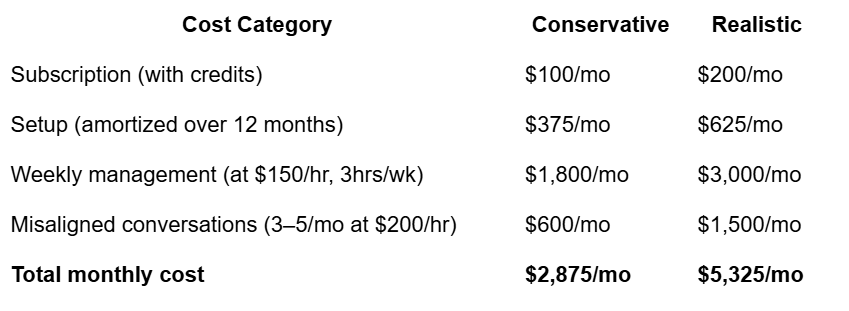
The subscription is not the expense.
Your time is the expense.
When Apollo Makes Sense
Let me be straight here, because credibility matters more than winning an argument.
Apollo makes sense if:
You have or plan to hire a dedicated outreach person. Not "you'll do outreach in addition to everything else." A person whose job includes managing and optimizing the tool.
You're targeting large, well-defined markets where volume is genuinely necessary to find 2–3 qualified leads per week. If your ICP is 50,000+ companies deep, Apollo's database is genuinely useful.
You're at a stage where you're building a sales infrastructure that will eventually support a team. Apollo is easier to scale than most alternatives. If you're building toward that, starting there may make sense.
You're running an agency or consulting firm with multiple outreach operators and enough volume to justify the tool's complexity.
If none of those describe you...
…you're probably paying for a tool that was designed for a game you're not playing.
If You're Playing a Precision Game Instead
Here's the honest version of this:
If you need to send 5,000 emails a month, Precision-Based Outreach is not for you. Apollo might be exactly right.
But if you need 2–4 new clients per quarter, and you're billing $150–$300/hour, and you have 3–5 hours a week for business development...
The math doesn't require 5,000 emails. It requires finding the right 20–50 people and saying something genuinely relevant to them.
That's Precision-Based Outreach. And it runs on a completely different logic than Apollo.
Instead of a database of 275 million contacts, you need a process for identifying the 20 people worth reaching out to this month.
Instead of automated sequences, you need outreach that sounds like you — because your name and your reputation are the offer.
Instead of A/B testing subject lines across 500 sends, you need judgment about what this specific person is dealing with and why your offer fits their situation right now.
The tool requirement for Precision-Based Outreach is much smaller. The judgment requirement is much higher.
That's the trade. And for consultants and online service providers operating under a different leverage model — where time is expensive, reputation is the pipeline, and you only need a handful of great clients — it's the right trade.
If You're Realizing the Problem Isn't the Software
Truth is, most consultants and online service providers who've tried Apollo and felt frustrated didn't do anything wrong.
They used a well-built tool that was designed for a different operator, running a different outreach model, solving a different math problem.
If that's landing for you... come learn what the precision game looks like instead.
This Thursday at 1pm MT, I’m running a free, live training called Never Stare at a Cold Email Again.
It's not a pitch or a replay dressed up as a “live, on demand” webinar.
This is a live training on what we've been talking about here:
Why volume works for SaaS but breaks down for consultants and online service providers — and why that's a model problem, not a personal one.
How to close The Judgment Gap — what it looks like to run outreach built around your judgment instead of a database.
How to run Precision-Based Outreach in 3 hours a week — the exact framework I use and teach inside The WARM Client Method, live, so you can see it before you invest a dollar.
If you've been using tools built for a different game and wondering why it feels so hard...
Come see what the precision game looks like.
→ Register for Never Stare at a Cold Email Again — free training on Thursday at 1pm MT
Also in this series: [Lemlist] · [Woodpecker] · [Hunter] · [ListKit]
← Back to: Cold Email Software for Consultants and Online Service Providers