
Cold Email Software for Agency Owners and Online Service Providers: Precision-Based Outreach vs Volume
Most cold email software is built for one thing: volume.
Send more.
Automate more.
Optimize more.
And sure, that model works for sales teams, SDRs, agencies with dedicated outreach staff.
It doesn't work well for agency owners and online service providers.
Not because cold email doesn't work.
Because agency owners + online service providers operate under a different leverage model. Your time is billed at $150–$300/hour. Every hour you spend tweaking sequences and scrubbing lists is an hour you're not billing or delivering.
Not building the kinds of relationships that actually convert.
This post breaks down why most cold email tools are designed for Volume-Based Outreach — and why that creates a specific, predictable kind of frustration for agency owners and high-ticket online service providers.
Then I'll introduce a different model: Precision-Based Outreach, and the concept of The Judgment Gap, which is the real bottleneck that most outreach tools never address.
Why Cold Email Feels Hard for Agency Owners + Online Service Providers
Consider this:
A consultant or service provider — smart, experienced, $150K+ a year — decides to get serious about cold outreach.
So, they pick a tool, watch the tutorials. And they build a list, set up sequences, warm up a domain.
Six weeks later?
They've sunk in 20+ hours, sent 300 emails, gotten 8 replies, booked 1 call, and that call went nowhere.
And they're exhausted.
Not because they did it wrong. Because the model they were handed wasn't built for how they work.
What this means for you:
Decision Fatigue Before You Send a Single Email
Setting up cold email is sold as a one-time project.
Truth is:
It’s not.
Before you write your first email, you're making a stack of decisions you didn't see coming, like:
Which tool?
Which domain to use for sending?
Which list source?
Which job titles to filter for?
Which company size?
Which industries?
Then the email decisions:
How long should the sequence be?
How many follow-ups?
What delays between them?
What's the hook?
What's the call to action?
How much personalization and how the heck do I get those custom fields to populate correctly?
And then the meta-decisions:
What counts as a good reply?
What do I do with "not right now"?
Should I follow up with everyone or just some people?
Is it worth replying to a “not a good fit” reply? (And if yes, what do I even say?)
Each decision feels small.
Together, they create a decision load that takes days — sometimes weeks — to work through.
And you haven't sent a single email yet. Heck, I’m exhausted just reading through the bullet points.
Why this happens:
Volume-Based Outreach is designed around uncertainty.
The whole model assumes you don't know exactly who to target or what to say. So you make your best guesses, send a lot, and let the data tell you what's working.
That's a reasonable approach...
…if data is cheap and time is plentiful.
But for you billing $250/hour?
Time has a specific cost: $250/hour.
Decision fatigue isn't a personal weakness. It's a structural feature of a model that wasn't designed for your economics.
The Optimization Trap
Once you're running, cold email software gives you something that looks like progress:
Data.
Open rates. Reply rates. Click-through rates.
Which subject line beat the other one by 4%.
Maybe even heatmaps of when people opened your email, if you got feisty during setup.
A/B test results on two subject lines with a sample size of 40.
And all that data looks super cool and you feel super productive until…
You look at the results, which are 1-2 new clients.
Surely you could get more.
So you optimize.
You tweak the subject line. You rewrite the first sentence. You shorten the follow-up. You try a different call to action.
This is called optimization. And for a sales team running thousands of sequences, small percentage improvements across high volume add up to real results.
For a consultant or online service provider sending 30–50 emails a month?
You're optimizing a sample size too small to be statistically meaningful.
What’s happening is you're mistaking noise for signal. And you're spending hours — billable hours — on marginal changes that don't meaningfully move your pipeline.
I know well this optimization trap. It’s seductive because you feel productive.Look, ma, at all this good work of being analytical and improving stuff.
Except:
What you're actually doing is substituting activity for judgment.
And judgment is exactly what makes agency owners & online service providers effective. Replacing it with metric-chasing is working against your actual competitive advantage.
List Overwhelm: When More Contacts Creates Less Clarity
Most cold email tools are engineered to help you build a bigger list.
Filters, integrations, enrichment tools, CSV imports — the whole infrastructure points toward scale.
So you build a list. 500 contacts. Maybe 2,000.
And then you look at it...
…and feel a low-grade dread.
Because you don't know which of these people are the right people.
Sure, you’ve got data points, but not a picture.
So many job titles and company sizes — but no context about what they're dealing with right now, whether they'd care about what you offer, whether they're even worth reaching out to.
Volume-Based Outreach solves this with quantity:
Only 3-5% of the market at any given time are actively looking for your solution. To find them, you must wade through the 95-97% of the market who aren’t right.
For agency owners and online service providers, this creates a different problem:
A large list feels like momentum but diffuses your focus.
Every name is a silent question: Is this person actually a fit? Do I know enough about their situation to say something true?
Or am I just hoping the template lands?
That uncertainty doesn't shrink when you send more emails.
It compounds into low-quality conversations, wasted time + energy on mismatched discovery calls, and a slow creep of doubt that maybe this whole thing isn't working.
Volume Pressure: The Implicit Message in the Dashboard
Spend a week inside most cold email tools and you'll notice something:
Every metric pushes toward more.
More contacts added. More emails in the queue. More follow-ups scheduled. More sends this week than last.
This idea of “bigger is better.”
That's not a bug; it's the model. Volume-Based Outreach is optimized for throughput. The dashboards are built to surface where you're underperforming against volume benchmarks.
For a sales team running 1,000+ sends a week, that pressure is useful. It tells them when activity has dropped below the level that produces results.
For a consultant or online service provider billing $250/hour...
Well, those 4 hours a week managing outreach volume is a $1,000 cost.
Not counting setup time. Or the mental overhead of monitoring a system that never feels quite dialed in.
The implicit message of every volume dashboard: you should be sending more.
For agency owners and online service providers, that message is wrong.
Low Reply Quality: When the Wrong People Respond
What doesn't show up cleanly in any metric is:
Volume-Based Outreach optimizes for reply rate.
The sequences, the subject lines, the follow-up cadences — all of it is engineered to generate a reply.
However, not necessarily the right reply.
So you run a campaign.
You get a 3% reply rate. That sounds okay.
Then you open the actual replies.
Some are curious with no real fit. Others are "forward this to my colleague" (the colleague who will not respond). And still others are "not right now" with no timeline. Loads are “wrong email address.”
A few replies show genuine interest…
but from people who want something different than what you offer, or who are at a company that's not a match.
And maybe one or two are qualified.
For a high-volume B2B sales team, 3% reply rate with 10% of those converting is math that works. For a consultant who spent six weeks sending 200 emails and got four real conversations...
…the ROI looks very different when you account for the time you put in.
Low reply quality isn't a copy problem. And it isn't a subject line problem.
Instead, low reply quality is a model problem. When you optimize for volume, you cast a wide net. Wide nets catch a lot of things that aren't what you're fishing for.
So What's Going On Here?
Let me be clear about something:
None of this means cold email doesn't work for agency owners or online service providers.
Rather, it means the tools and frameworks built for Volume-Based Outreach create a predictable set of friction points for people who operate under a different leverage model with:
Decision fatigue
Optimization traps
List overwhelm
Volume pressure
Low reply quality.
These aren't problems you fix with a better tool or a better template.
These are structural problems that are baked into an approach that was designed for a different kind of operator -- one with a sales team, a dedicated outreach budget, and a business model that runs on throughput.
Agency owners and online service providers run on something else entirely: judgment.
And here's the thing about Volume-Based Outreach — it doesn't have a place for judgment.
There's no field in the dashboard for "I know this person's situation."
No metric for "this one email is worth sending to three people, not three hundred."
That gap — between what the tools are built to measure and what actually drives results for agency owners— is what I call The Judgment Gap.
And it's what the rest of this post is about.
The Two Models of Cold Outreach
Nobody tells you this when you sign up for a cold email tool:
There are two fundamentally different models of cold outreach.
And they're not compatible.
The first one was built for sales teams chasing pipeline at scale.
Most tools you've heard of are built for the first model.
That's not a criticism.
It's just a fact worth understanding before you spend 6+ weeks setting something up.
Volume-Based Outreach
Volume-Based Outreach operates on one core assumption:
scale solves pipeline problems.
If you don't know exactly who to target, simply send more and let the replies tell you.
And if conversion rates are low, increase volume until the math works.
If you're not sure what to say, run A/B tests across thousands of sends until something surfaces.
This model was designed for SDR teams — salespeople whose full-time job is outreach, who have dedicated tools, dedicated time, and a business model that absorbs the cost of low-conversion experimentation.
The operating logic:
Automation > discretion
Data > judgment
Volume compensates for uncertainty
Optimization is an ongoing, full-time process
It works, if you’re the operator it was designed for.
Precision-Based Outreach
Precision-Based Outreach starts from a different assumption:
you already know who your best clients are. The job is finding more of them — not experimenting your way toward them.
It's optimized for selectivity. Smaller send volume. Careful prospect research before a single email goes out. Outreach designed to start a high-quality conversation, not generate a reply-rate metric.
The operating logic:
Judgment > automation
Fewer, better-researched contacts
Higher relevance per email
Designed for online service providers who bill by the hour (or retainer) and can't afford to waste time on mismatched conversations
For agency owners, online service providers…
this is the model that fits how you work.
The difference is about where the effort goes.
In Volume-Based Outreach, effort goes into building systems that can scale.
Compared to Precision-Based Outreach where effort goes into identifying the right people and saying something relevant to them.
One scales through automation. The other scales through better judgment.
Which brings us to the problem most agency owners and online service providers run into.
The Judgment Gap
Let me give you a concept that explains a lot:
The Judgment Gap is the space between access to automation and strategic client selection. It occurs when agency owners and online service providers outsource decision-making to tools built for volume.
What that means in practice is:
You have a tool. The tool can send 500 emails a month. It can automate follow-ups, personalize at scale, track every open and click. It's genuinely powerful.
But the tool can't answer the most important question in your outreach:
Is this person actually worth reaching out to?
That question requires judgment.
It requires knowing your best clients well enough to recognize a version of them when you see one.
It requires understanding context — what this prospect is dealing with right now, whether your offer actually fits their situation, whether this is a conversation worth starting.
Volume-Based Outreach sidesteps that question. Because it says: don't answer it — just send more and let the replies filter it out.
For agency owners and online service providers, that's where the Volume-Based Outreach model breaks.
Because the cost of a mismatched conversation isn't just a low reply rate.
It's an hour of your time on a discovery call that leads nowhere. And the wasted energy and prep time you took to get ready for that discovery call.
It's your name attached to an outreach campaign that didn't feel like you.
And it's a small but very real hit to your reputation in a market where reputation is everything.
The Judgment Gap is why agency owners and online service providers feel like cold email isn't working — even when technically everything is set up correctly.
The tool is working. But the model you’re using is wrong.
Closing The Judgment Gap means building outreach around your judgment, not around the tool's capacity to send at scale.
That's the entire premise of Precision-Based Outreach.
Why Agency Owners and Online Service Providers Operate Under a Different Leverage Model
I want to be specific here, because "agency owners and online service providers are different" is easy to say.
And easier to dismiss.
Here are 5 things that make the leverage model different — and why those 5 items matters for outreach.
1. No SDR team.
You are doing this yourself. There is no team of people whose job is to send, manage, and optimize outreach. The time cost of every setup decision, every optimization loop, every list-cleaning session lands entirely on you.
2. Personal brand risk.
When a sales team sends a bad cold email, it reflects on the company. When you send a bad cold email, it reflects on you — personally, professionally, in the market where your reputation is your pipeline. There is no buffer between your outreach and your brand.
3. Limited weekly bandwidth.
Most agency owners working at a healthy pace have somewhere between 3–8 hours a week they can realistically dedicate to business development. That's it. Volume-Based Outreach assumes you can treat outreach like a part-time job. You can't. And you shouldn't have to.
4. You only need 2–3 clients per quarter.
This is maybe the most important one.
A SaaS company needs thousands of customers. Their outreach math requires volume — because the percentage of people who convert will always be small, and the business only works if enough of them do.
You need two or three good clients a quarter. Maybe five, if your offers are lower-ticket.
That math does not require 5,000 emails a month. It requires finding the right 20–50 people and saying something that resonates with them.
Volume-Based Outreach is solving the wrong math problem for your business.
5. Reputation sensitivity.
Agency owners and online service providers live and die by referrals, repeat work, and word-of-mouth in tight networks. One bad outreach campaign — spammy, off-target, impersonal — doesn't just waste time. It can actively damage the reputation you've spent years building.
The downside risk of misaligned outreach is higher for agency owners than for almost any other business model.
Put all of this together and the picture is clear: agency owners and online service providers operating under a different leverage model need a different outreach model.
Not a scaled-down version of Volume-Based Outreach.
But a structurally different approach built around the constraints and strengths of how they actually work.
A Neutral Look at Popular Cold Email Tools
Before I go further, let me be direct about something.
The tools below are good tools. Well-built, well-supported, with real teams behind them.
I'm not here to tell you they're bad.
I'm here to tell you what they're designed for, so you can make an informed decision about whether that design matches how you work.
Apollo is a full-stack sales intelligence and engagement platform.
It's built for sales teams that need contact data and a sequencing tool in one place.
The contact database is extensive. The sequencing is powerful.
It's designed for high-volume prospecting — SDR teams, growth-stage companies, agencies running outreach at scale. If you need to find 10,000 leads and work them through a sequence, Apollo is built for that.
Lemlist is a cold email platform with strong personalization features — image personalization, video embeds, multi-channel sequences.
It's a good tool for teams that want to stand out in crowded inboxes at scale.
The personalization features are genuinely differentiated.
The model is still Volume-Based Outreach — the personalization is designed to improve reply rates across large send volumes, not to replace the judgment of who to contact.
Woodpecker is a reliable cold email sequencing tool with solid deliverability features.
It's popular with agencies and sales teams that want a clean, focused sequencing experience without a full CRM.
Strong on automation, scheduling, and multi-inbox sending. Built for teams running consistent high-volume campaigns.
Hunter is primarily a prospecting and email-finding tool.
It's designed to help you find and verify email addresses at scale. Often used as a list-building layer on top of a sequencing tool.
Clean, well-built, does one thing well. Useful regardless of your outreach model — though how you use the contacts you find is where model alignment matters.
ListKit is a B2B contact database and list-building tool, designed to help you build targeted prospect lists quickly. Heavy filtering options, verified contact data.
Built for teams that need to move fast on list-building and want clean data to feed into a sequencing workflow.
A pattern worth noticing: every tool above is optimized for some version of the same workflow:
Find more contacts
Send more emails
Automate more follow-ups
Track more metrics.
That's Volume-Based Outreach infrastructure. It's not designed around The Judgment Gap. It's designed to scale past it.
Whether that's the right design for your business is the question worth sitting with.
The Hidden Cost of Misalignment
Let's talk about money.
Specifically, yours.
Most agency owners and online service providers evaluate cold email tools by subscription cost.
Which is the wrong number to look at.
The real cost of misalignment has four components — and subscription cost is the smallest one.
1. Subscription cost
Most cold email tools run $50–$200/month depending on contact volume and features. Apollo's paid plans start around $49/month and scale significantly with usage. Lemlist starts around $59/month. Woodpecker around $54/month.
Call it $100/month as a reasonable midpoint. $1,200/year. Manageable.
That's not the problem.
2. Setup time cost
Realistically, getting a cold email system up and running — domain setup, warm-up period, list building, sequence writing, tool configuration — takes 15–25 hours if you've done it before. Longer if you haven't.
At $150/hour (the low end of the consultant rate range), 20 hours of setup is $3,000 in time cost.
At $300/hour, it's $6,000.
That's the cost of setup alone — before you've sent a single email.
3. Weekly management cost
Volume-Based Outreach isn't a set-it-and-forget-it system. It requires ongoing management: monitoring reply rates, handling responses, cleaning lists, adjusting sequences, troubleshooting deliverability, re-warming domains after issues.
Conservative estimate: 3–5 hours per week for a solo operator running a real campaign.
At $200/hour, that's $600–$1,000/week. $2,400–$4,000/month.
Even if you value your business development time at half your billable rate — $100/hour — you're spending $1,200–$2,000/month in time.
On a system built for a different operating model.
4. Strategic misalignment cost
This one is harder to quantify, but it's real.
When your outreach model doesn't match your business model, you end up in conversations with the wrong people. Discovery calls that go nowhere. Proposals that don't land. Relationships that fizzle because the fit was never actually there.
Each one of those conversations costs you time — an hour or two at minimum, often more. At $200–$300/hour, each misaligned conversation is a $200–$600 cost.
Run three to five of those a month and you're looking at $600–$3,000 in strategic misalignment cost, month after month, on top of everything else.
The actual math
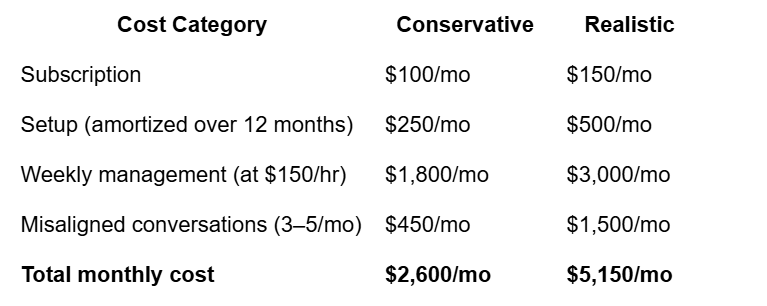
The subscription is not the expense.
Your time is the expense.
And the question isn't whether you can afford the tool. It's whether the model the tool is built on makes sense for how your business actually works.
If You're Playing a Precision Game Instead
If you need to send 5,000 emails a month, Precision-Based Outreach is not for you.
Volume-Based Outreach exists for a reason, and it works at scale for the business models it was designed for.
If that's your situation, you should use a tool built for that model.
Precision-Based Outreach is for a different kind of operator.
Volume limits by design.
Precision-Based Outreach doesn't try to send as many emails as possible. It deliberately limits volume — not because sending more is too hard, but because sending more to the wrong people is a waste of the judgment that makes agency owners effective.
You send fewer emails. To better-researched people. With more relevant context. And you get higher-quality conversations as a result — not despite the lower volume, but because of it.
Deliverability protection.
Lower send volume, better-targeted contacts, and higher engagement rates all work together to protect your sender reputation. You're not burning through domains. You're not fighting spam filters. You're operating in a way that email providers reward — because your recipients are actually opening and responding.
Reputation protection.
Every email you send is attached to your name. In a small, relationship-driven professional market, one poorly targeted campaign can do real damage to the trust you've built.
Precision-Based Outreach isn't just a lead generation strategy. It's a reputation management strategy. When the emails you send are well-researched and genuinely relevant, the worst-case scenario isn't "spam complaint" — it's "not right now." That's a very different downside.
What Precision-Based Outreach requires from you:
Not more time. Different time.
Instead of hours spent managing sequences and monitoring dashboards, you spend time on the front end — identifying the right people, understanding their situation, and writing outreach that reflects that understanding.
That's The Judgment Gap, closed from the right direction.
You're not automating past the judgment.
Now you're leading with it.
Come Learn This Live (Free)
This Thursday at 1pm MT, I’m running a free, live training called Always Know Where Your Next Client is Coming From (Even if Referrals Dried Up).
It's not a pitch or a replay dressed up as a “live, on demand” webinar.
This is a live training on what we've been talking about here.
Specifically:
Why volume works for SaaS but breaks down for agency owners and online service providers — and why that's not a personal failure, it's a model mismatch.
How to close The Judgment Gap — what it actually looks like to build outreach around your judgment instead of your send volume.
How to run Precision-Based Outreach in 3 hours a week — the exact framework I use and help you install inside The WARM Client Method, broken down live so you can see how it works before you ever invest a dollar.
If you've spent time trying to make cold email work and walked away feeling like you were doing it wrong...
…you probably weren't doing it wrong.
Because you were using a tool built for a different game.
Come see what the precision game looks like instead.
Also in this series: [Apollo] · [Lemlist] · [Woodpecker] · [Hunter] · [ListKit]